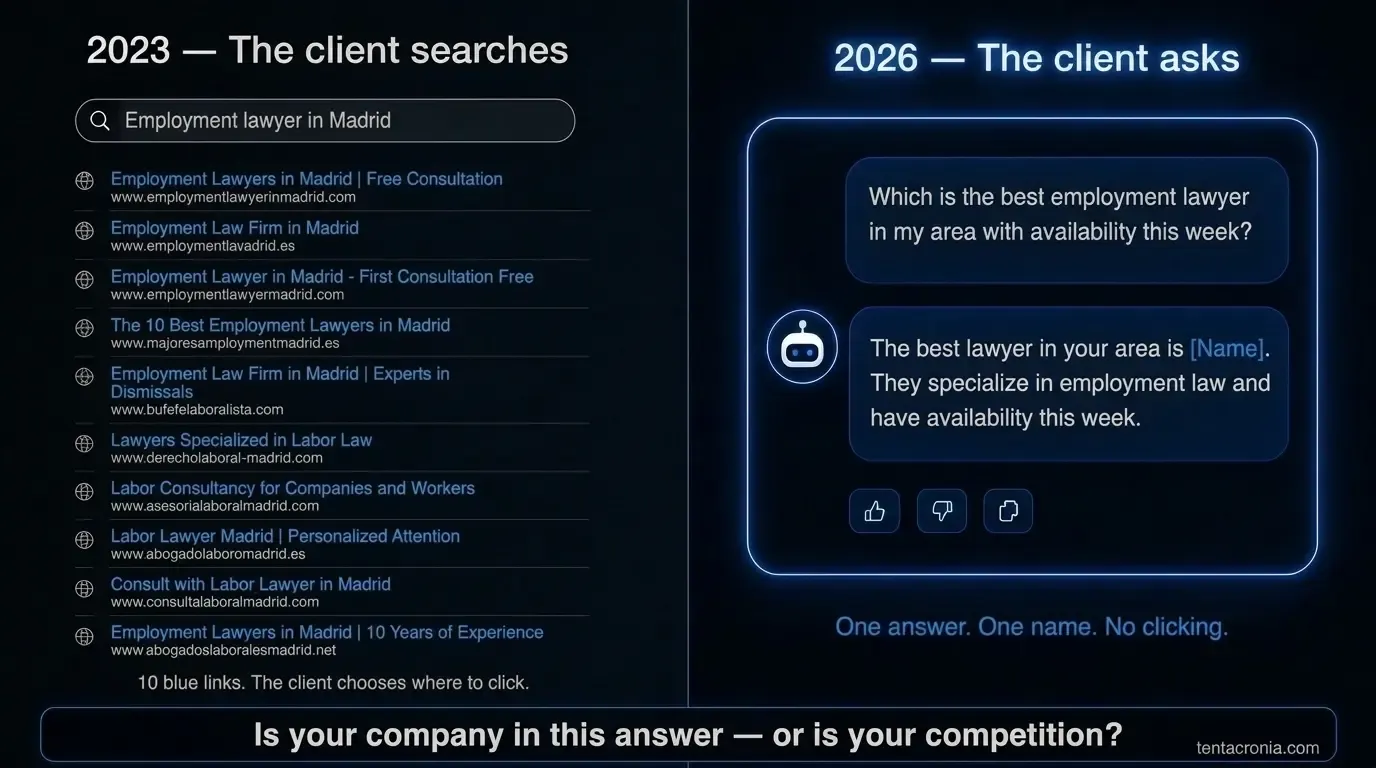
What Is GEO — and Why SEO Alone Isn't Enough in 2026
A few months ago, a prospective client called me, frustrated.
He had a website that ranked well on Google, good reviews, steady traffic. But when his customers started asking ChatGPT “who’s the best corporate labor law firm in São Paulo” — his name showed up nowhere.
His competitor showed up. He didn’t.
That moment sums up the problem most small and medium businesses are about to face.
What’s changing — and the data is clear
Gartner forecasts a 25% drop in traditional search traffic before 2026. It’s not an opinion — it’s a projection based on a behavior shift that’s already underway: people are moving away from clicking links and starting to ask AI directly.
ChatGPT. Gemini. Perplexity. Claude.
When someone asks “who’s the best labor lawyer in Madrid” or “which financial consulting firm do you recommend in Barcelona,” the AI doesn’t hand back a list of links. It gives an answer. With names. With recommendations.
And if your business isn’t optimized for that moment, it simply doesn’t exist in that answer.
SEO vs. GEO — what’s the real difference
SEO optimizes your website to rank in Google’s results. It runs on rankings, keywords, and backlinks.
GEO (Generative Engine Optimization) optimizes your website to be cited in AI-generated answers. It runs on content structure, technical data, and entity authority.
They’re different channels, with different logic.
| SEO | GEO | |
|---|---|---|
| Goal | Rank in Google’s results | Get cited in the AI’s answer |
| Main signals | Keywords, backlinks, speed | Content structure, structured data, entity authority |
| What the user sees | A list of 10 blue links | One direct answer, with a name |
| Who chooses | The user, among several options | The AI, deciding what to cite |
A website can have excellent SEO and be completely invisible to ChatGPT. Likewise, a website with little organic traffic can be cited regularly by Perplexity — if it has the right signals.
Research published at KDD 2024 (Princeton, IIT Delhi): websites optimized with GEO methods see between +30% and +115% higher visibility in AI-generated answers. The impact is greatest precisely on lower-authority sites — meaning small and medium businesses have a real window of opportunity right now, before bigger competitors claim that space.
And here’s the real opportunity: even though the volume of direct clicks from AI is lower than classic Google traffic, visitors who arrive via a ChatGPT or Perplexity recommendation have already finished their research. A peer-reviewed study (Marketing Science, INFORMS 2026, 973 companies) confirms that AI-referred visitors convert 2 to 3 times more than organic traffic in B2B services, due to their very high purchase intent. It’s not just more visibility — it’s traffic that arrives ready to decide.
What AI systems look for in a website
For a traditional search engine, what matters is: speed, keywords, backlinks.
For an AI system, what matters is different:
1. Content citability Is the text structured so it can be extracted directly as an answer? AI prefers short paragraphs, direct questions and answers, and concrete, data-backed statements.
2. AI crawler access Can GPTBot, ClaudeBot, and PerplexityBot read your site? Many sites block them without knowing it, through a misconfigured robots.txt.
3. Structured data (schema markup) Can the AI tell you’re a clinic in Barcelona and not a clothing store in Madrid? Schema markup is the technical language that makes that identification possible.
4. Entity authority AI shows a systematic, massive bias toward third-party sources over a brand’s own content. To avoid hallucinations and promotional bias, ChatGPT and Perplexity prioritize what independent press, forums, directories, and external blogs say about you — not what you say about yourself on your own site. (Chen et al., arXiv:2509.08919, 2025)
Ahrefs analyzed 75,000 brands and confirmed that brand mentions are 3 times more decisive than backlinks for appearing in AI answers. What others say about you matters more than what you say about yourself.
5. llms.txt A new, still little-known file that lets your website communicate directly with AI systems. It works like an index: it tells ChatGPT and Perplexity what your business is, which pages matter most, and what you don’t want ignored. It’s the equivalent of robots.txt — but for generative AI.
Where to start
You don’t need to rebuild your website. In most cases the fixes are surgical — but knowing exactly which ones requires a prior diagnosis.
As a starting point, there are three questions every small or medium business should ask itself today:
1. Can AI get into your website? There’s a technical setting that determines whether ChatGPT’s, Perplexity’s, or Gemini’s bots can access your content. Many sites block them without knowing it.
2. Does AI know what kind of business you are? Without the right technical signals, an AI system can’t tell whether you’re a clinic, a consultancy, or a shop. And what it can’t classify, it rarely cites.
3. Does your brand exist outside your own website? This is what surprises our clients most the first time they see it.
Answering these three questions precisely — and knowing what to do with the answers — is exactly what we do in Tentacron IA’s initial diagnosis.
Want to know how ChatGPT and Perplexity see you today?
At Tentacron IA we run that diagnosis — free, within 48 hours, no obligation. We analyze how the leading AI systems see your website today and deliver an initial report with the critical points limiting your visibility.