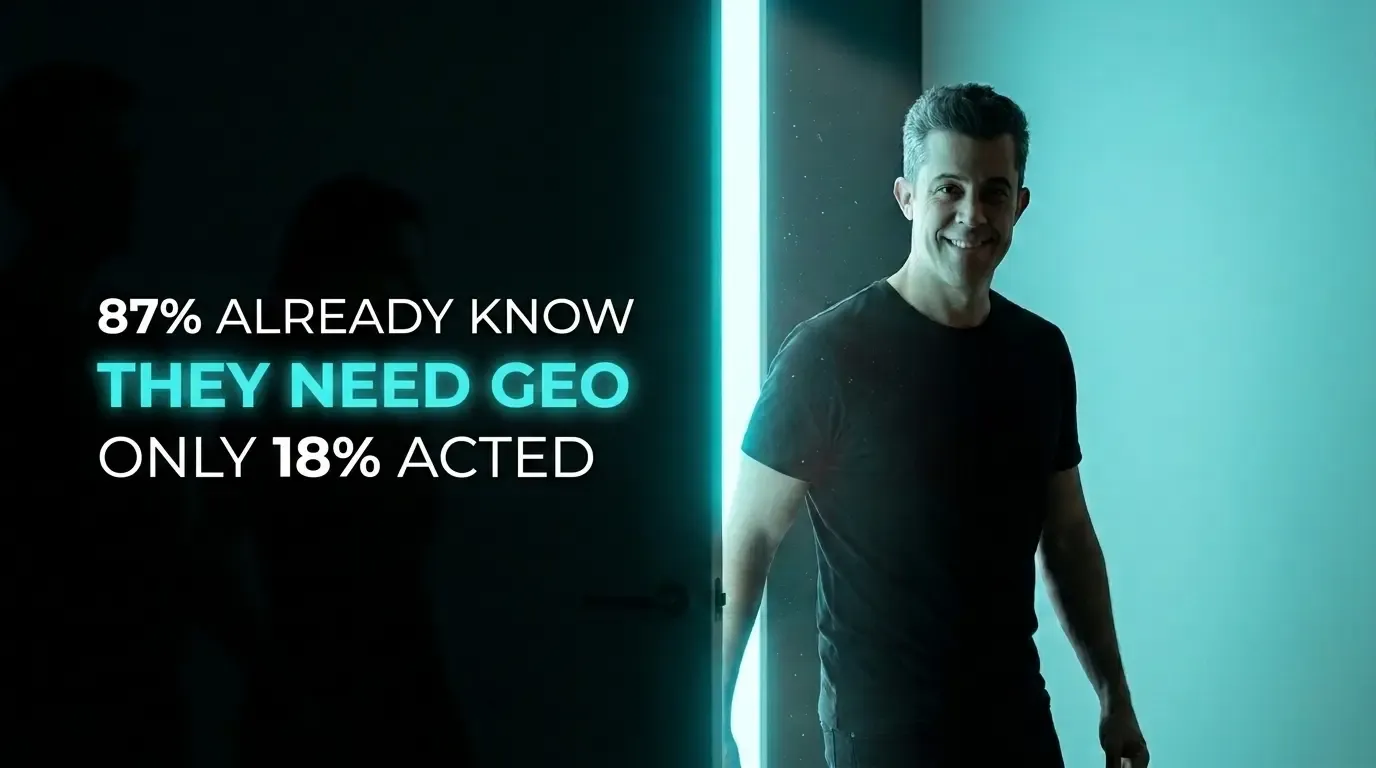
87% of Companies Know They Need GEO. Only 18% Did Something About It
There’s a question almost no business leader has asked yet: “what is ChatGPT saying about my company right now?”
A recent study of 105 Spanish business leaders measured exactly that gap — between knowing the problem exists and actually doing something about it. The result is the kind of data point that should make anyone running a business uncomfortable.
The gap: 87.3% know, 18.2% acted
The Actions GEO/AEO 2026 study, with fieldwork among general management, marketing, communications, SEO, and digital transformation leaders, found the following:
| Indicator | % of companies |
|---|---|
| Considers appearing in AI responses key to their future visibility | 87.3% |
| Already has some GEO/AEO initiative underway | 18.2% |
| Has GEO integrated into their strategy | 3.6% |
Nearly 9 out of 10 leaders already understand this matters. But only 2 out of 10 did something concrete about it. And when asked why, the most common answer wasn’t “no budget” or “no time” — it was lack of knowledge (43.6%). This isn’t a money barrier. It’s an information barrier.
That gap — between knowing and acting — is exactly the space where a small or mid-sized company can still get ahead of a bigger one that hasn’t moved yet.
Three signals that the window is closing
What makes this gap urgent, not just curious, are three real developments that happened in the last few weeks — not predictions, already-confirmed facts.
1. Venture capital already placed its bet: Profound is worth $1.8 billion
Profound, an AI visibility monitoring startup founded in 2024, closed a $180 million Series D led by Sequoia Capital and Kleiner Perkins, reaching a $1.8 billion valuation — nearly double the $1 billion valuation it had just seven months earlier. It now serves more than 700 enterprise customers, including roughly 10% of the Fortune 500.
This isn’t a startup curiosity. It’s a signal that some of the world’s most sophisticated investors have already decided that “knowing how AI sees you” is a permanent software category, not a passing trend.
2. Advertising has already entered the conversation with AI
On August 24, 2026, OpenAI launched ChatGPT Ads in 31 European markets — Spain, Germany, France, Italy, the Netherlands, Sweden, Austria, and the rest of the EU, plus Iceland, Liechtenstein, Norway, and Switzerland. Ads only appear to users on free plans, with self-service access via Ads Manager arriving later that same summer.
This changes the playing field: before, the only goal was getting AI to mention you organically. Now there’s also the option of paying to appear inside the conversation itself. GEO no longer competes only against traditional SEO — it’s starting to share space with a brand-new advertising channel.
3. The European Union itself is reshaping the board
On September 29, 2026, Google took the European Commission to the EU’s General Court in Luxembourg, asking to suspend an order forcing it to share certain search data with OpenAI and other rivals. The Commission is requiring that sharing begin in January 2027, with the stated goal of “rebalancing the playing field” between search engines and AI assistants.
Regardless of who wins the litigation, the fact itself is the news: a European regulator is actively pushing for more AI assistants to compete over the same information sources — not fewer. That means more surfaces where a brand needs to be present, not fewer.
What this means for a company that hasn’t done anything yet
None of these three signals, on its own, proves your specific company will lose customers if it doesn’t act this week. But together, they draw a pattern that’s hard to ignore: institutional money flowing in at scale, a new commercial distribution channel opening up inside AI assistants themselves, and a European regulatory framework pushing toward more competition among answer engines — not toward this being a trend that fizzles out on its own.
The practical question isn’t “should I worry about GEO?” — the 87.3% in the Spanish study already answered that one. The real question is: are you going to stay in the 87% that knows, or move into the 18% that already did something?
The scenario that actually matters
Think about your most direct competitor — the one fighting you for the same customer, in the same city or the same niche. Right now, both of you are most likely in the same place: the 81.8% that hasn’t done anything yet. That means that, for now, neither of you has an edge in how AI describes, compares, or recommends you.
That equality won’t last. At some point, one of you is going to move first — structuring your website, your content, and your data so ChatGPT, Gemini, and Perplexity can understand and cite you accurately. When that happens, the other one doesn’t just fall “a little behind”: they become invisible in the exact conversation where your shared customer is deciding who to hire.
This isn’t about being afraid of GEO. It’s about recognizing that, with a gap of 87.3% to 18.2%, the advantage of moving now doesn’t depend on being the biggest player in your sector — it only depends on being one of the first to move.
An honest limitation
The Actions study has a sample of 105 business leaders — solid for a market study, but not a national census, and we don’t have the full detail of its sample selection methodology. The other three signals (Profound, ChatGPT Ads, the Google-EU litigation) are independently verifiable facts, not projections — but none of them guarantee a specific outcome for your business. They’re market-direction indicators, not a promise of results.
Which side of the gap is your company on?
At Tentacron IA we run that diagnostic for free, in 48 hours, no commitment: we review what ChatGPT, Perplexity, and Gemini are saying about your business right now, and whether your website has what it takes to become part of those answers.
Request your free diagnostic → tentacronia.com
Sources: Actions, “Estudio GEO/AEO 2026: Grado de implantación y uso en las empresas españolas”, published September 10, 2026 · Profound Series D, AI Weekly coverage · OpenAI, “ChatGPT Ads expands across Europe” · Euronews, “Google appeals EU data sharing order, warns of irreversible harm”, September 29, 2026.